The heart can never grasp these unbearable early departures. —Jim Harrison, Complete Poems.
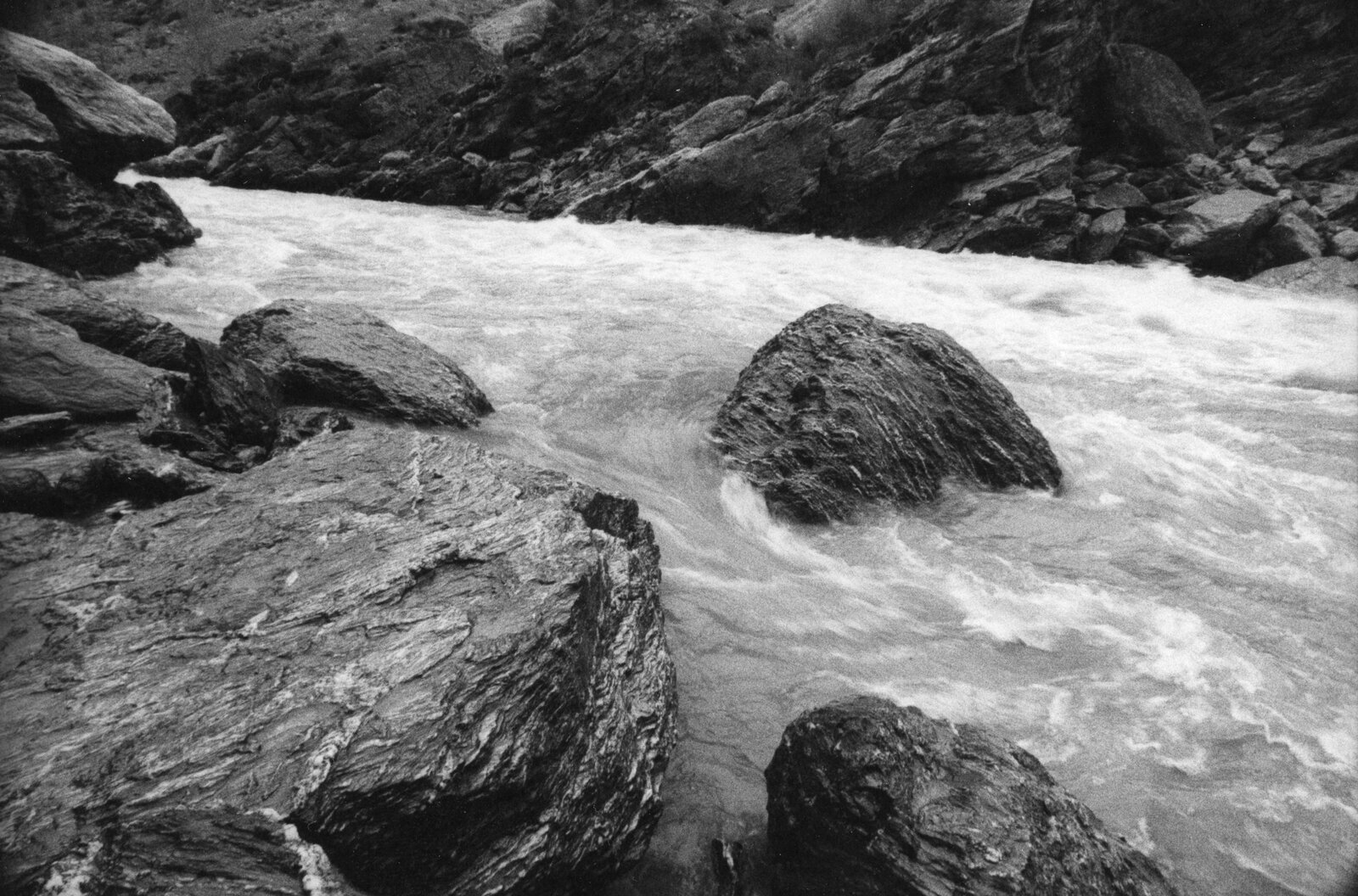
The Clutha River ran misty blue in the hot summer of early 1969. Within a couple of decades the great river would be stilled by the dam at Clyde, but in early ’69 it charged through the gorge like a wild animal—seething, rambunctious, at times deafening, and always cold.
On the tenuous terraces above the river, apricots, peaches and nectarines ripened in the hot sun and the heat that radiated from brown rock and tawny ground. Many said that the fruit that came from the trees on the terraced orchards was the finest in the land.
I was 18, had recently finished my second year at university and was picking fruit on Davidson’s Orchard above the river, just downstream of the Clyde Bridge. Some evenings, after a day picking fruit under a blistering sun, a group of us swam in a natural pool in the gorge the locals called “the sluicebox”. It was formed by jagged rock walls which protected it from the main flow, with rock benches at each end which allowed the chill water to enter and leave. I grew up beside the Mataura River. It was our pool in those early years, and I loved being in and around it, but the power of the Clutha scared me, as it has for all the years I have known it. There were moments, while cooling off in the sluicebox, with the roaring Clutha just a couple of arm lengths away, when I sensed its pull, as though it was alive.
A young man went missing that summer. He was, like me, a student from Dunedin working on an orchard in the gorge. Workers on the orchard often cooled off during their lunch breaks by swimming across the river; on one of those days the teenager was swept away. People searched for a week or so without finding any sign of him.
We need your help
READ MORE
A couple of weeks after the swimmer was lost, I was crossing the Clutha with a high school boy I worked with. We were on our lunch break, returning after checking for mail at the Clyde Post Office. Upstream of the bridge I saw what I thought was a swimmer mid-current, except this swimmer was not lifting his head to breathe. It took just a moment to realise that this was the body of the young man, finally released from the depths.
I asked the student to go back to the Post Office and call the police. Said I would follow the body downstream, fearing it might be lost again if it was thrust into the willow-lined banks.
I scrambled over dredge tailing, pushed through rose hip bushes and followed rabbit trails through fields of thyme, moving with the body as it floated downstream, alternating between a fast walk and a jog. Initially the body was held in mid-current, spinning in upwelling surges of water and whirlpools which at times lifted the dead swimmer, as though he was trying to make one more stroke with his stiff arms.
After around half an hour the current pushed the bloated body towards me. Still too deep for me to reach, but close enough, as it circled in a back-eddy, for me to see that the swimmer had lost part of an arm. I threw stones at the gulls that tried to land on his back. The body briefly tangled with a willow which lifted his head, exposing his sunken eyes and a face I couldn’t forget.
I had trailed the body for around an hour when I heard the sound of a jet boat approaching. The two police lifted it on board and covered it with a canvas sheet. They thanked me. Asked if I wanted a ride back to Clyde. I waved them off, unwilling to sit near the body.
I walked back to the orchard thinking about the young man, so much like me, and about his parents and others who loved him, happy that I had found him for them. I picked fruit in silence for the rest of the afternoon. That evening, I talked to my girlfriend about what happened. I remember the sadness of our conversation. Her father had drowned three or four years earlier, and she hadn’t talked to me about how she felt when he died. I stayed at her place that night, rather than going back to my hut at the orchard. I look back now, astonished how little we talked about the things that hurt us.
The swimmer was the first dead person I had seen. Dad had died three years earlier, but I didn’t see his body. For a couple of weeks I had trouble sleeping, seeing the swimmer’s face when I closed my eyes. In the years since, I have had a number of close shaves in rivers, feeling their power, and once in a while have feared for my own life. Some say it’s the best way to die, but I’m not convinced of that.
In 1989 I played a small part in the publication of The Last River Song, a book by Lloyd Godman, who captured, in a series of black and white photographs, the force of the Clutha River / Mata-Au as it flowed through the Cromwell Gorge. I have six of his original prints from the book, a reminder of the awful power and beauty of moving water, and of what has been lost. The river is quiet now where the young man drowned, as though the orchards and the wild river never existed.
WORDS: Dougal Rillstone
PHOTOS: Lloyd Godman
