Happy snow landings.

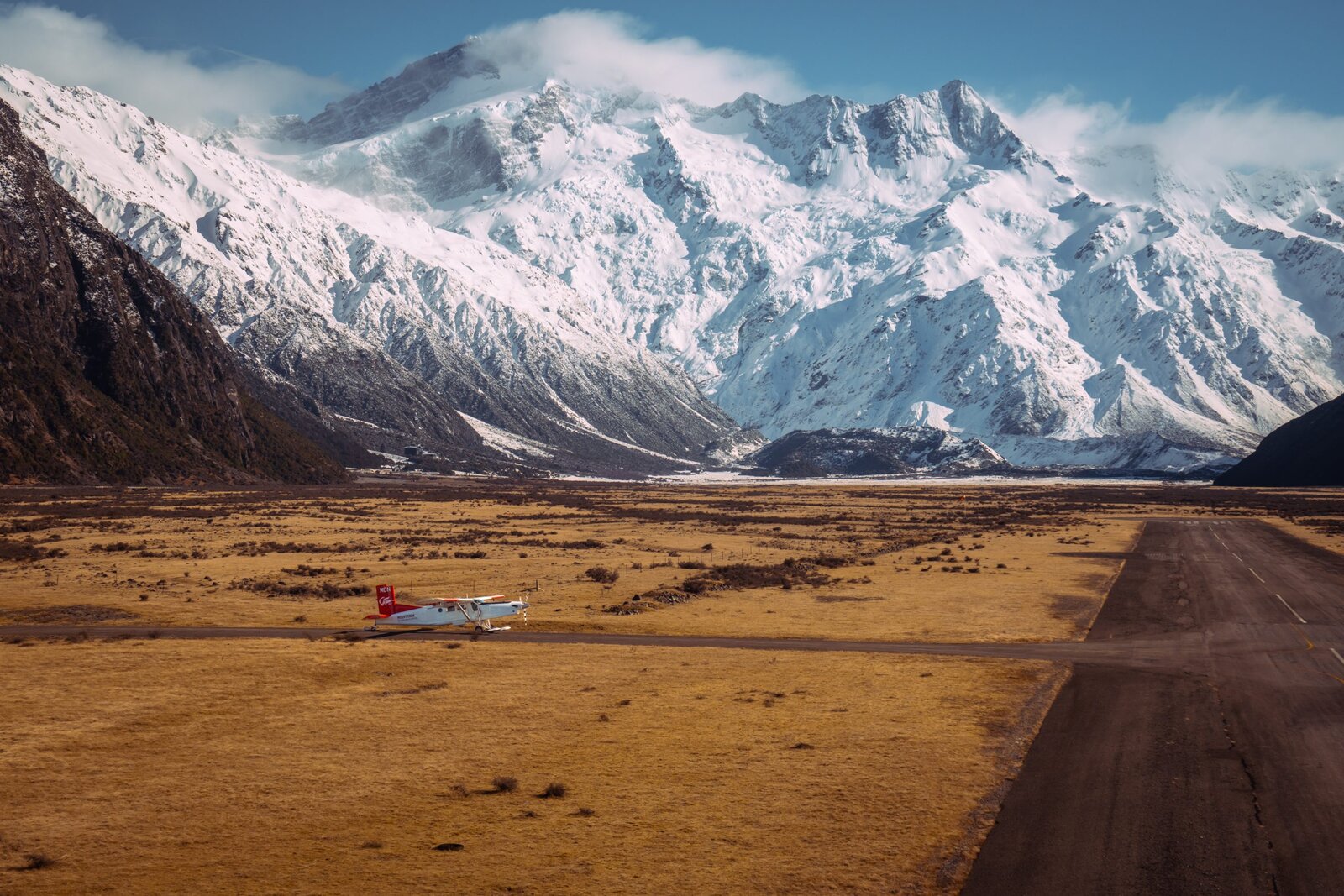
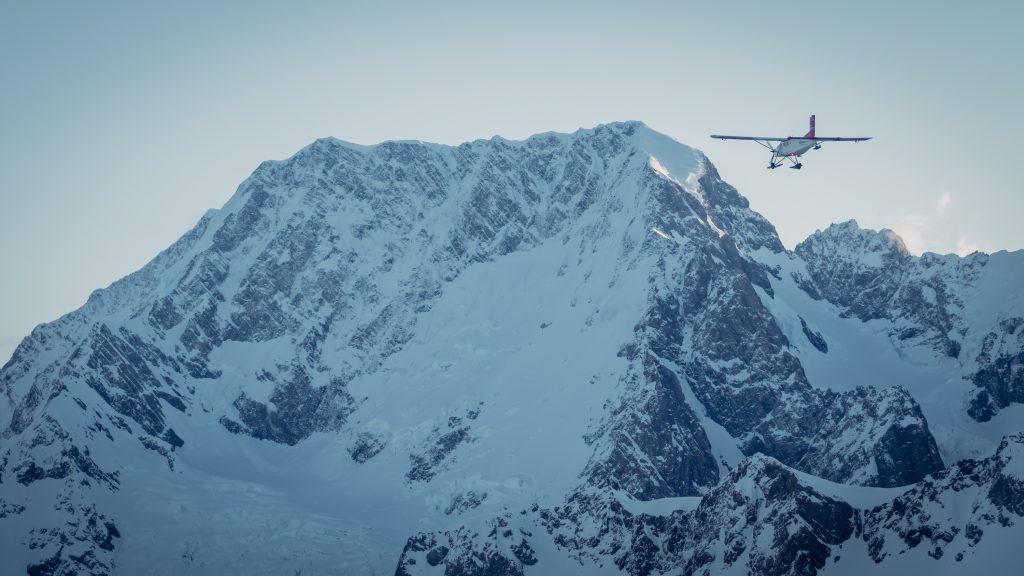
High above New Zealand’s knife-edge Southern Alps, a single engine Pilatus Porter is aiming to achieve the outlandish.
Aiding in its aerial quest are 600 horses of raw power, nearly 800 kilometres of range and velocity enough to make a bullet train sweat; this turboprop aircraft is a workhorse. But where it will go, no horse dares tread. Fortunately, the “Ol’Porter” is a refined machine, and the alps its alma mater. This airplane is the legacy of a distinctively Kiwi achievement in aviation: to flow like on a tide toward a tongue of snowladen glacier—and to ski it.
It’s been 70 years since one New Zealander trained his hawk-eye on making a thing never before seen in flying or, more specifically, in touching down. Remember that one-liner concerning a bar and the ensuing antics when a bloke walks in? In 1955, the venue was Aoraki Mount Cook and the bloke was Henry Rodolph Wigley, son of Rodolph and Jessie, founders of the Mount Cook Tourist Company of New Zealand, Aotearoa’s largest tourism operator in its day.
Born in 1913 in Fairlie, South Canterbury, Henry, or Harry to his mates, was heir apparent to a family-run firm with dominion over accommodation, ground transport, skiing, aviation, and supposedly the nation’s first campervan/motorhome (but that’s a different story). Yet despite all that had been established, Harry had loftier goals.
We need your help
READ MORE
Harry appreciated the good fortune he had: to be flown, and later to fly, regularly over the shadow of Aoraki Mount Cook and its astonishing surrounds. He was particularly mesmerised by the crescendo of dawn light across the immense fields of glacial ice nested at altitude.
For him, the high-country fostered challenge as well as opportunity, framed by a toothy horizon. It was special. And as unforgiving as the high alpine zone could be, Harry saw too there were ample periods when those otherworldly icefields were as gentle as pastureland. If access could somehow be achieved—safely—generations of New Zealanders would flock for a chance to experience this dreamscape for themselves. Over the bristles of a meticulously sculpted moustache, he surveyed a world in which the sky truly was the limit.
Harry had a unique skillset made for the job. He started his pilot training before he turned 20, and later served in the Pacific during WWII, reaching the rank of wing commander in 1945. Flying a Havilland Tiger Moth, he also pioneered aerial search and rescue in the Southern Alps. On the ground, he captained the New Zealand ski team and was national downhill ski champion in 1936. It’s no wonder he put ski and sky together.
Harry puzzled and he tooled until September 22, 1955, when his window of opportunity opened to try his plan out for real. By mid-afternoon, Harry had already been parked up for hours at the Hermitage aerodrome, weighing the merits of flight-testing a design which, up until that point, had existed as a wooden scale model and a prototype featuring skis made with Formica countertops robbed from the family kitchen. But there was nothing more for it; now was the time. Adorned in tweed and buckled firmly into the seat of an Auster Aiglet—the aircraft that preceded the Porter—he taxied toward the next chapter in adventure aviation lore. Surviving members of the immediate Wigley family recall Harry as meticulously organised, each day planned down to the last detail. But not a manjack at the airfield that day was sure what the next moment might bring, Harry included.
For aid in event of emergency, to act as eyewitness, and to provide general emotional support, Harry had invited Alan ‘Squib’ McWhirter along. Together the pair soared upwards into endless sapphire. Harry’s children, as well as those close to the Wigley’s tourism concerns, still marvel that the endeavour managed to avoid mishap. When the old Auster touched down the Upper Neve of Tasman Glacier, it was a world first. Yet what actually met pilot and passenger in this moment of history-making was profound silence. Later, the newly-knighted Sir Harry compared the aviation milestone to a gadfly landing at the South Pole.
Ski-equipped aircraft had been used for snow take-offs and landings, but there had been no precedent for an aircraft able to execute both conventional and snow touchdowns in a single flight. The Auster had been fitted in the Mt Cook Company’s Timaru workshop with a hydraulic retractable system. The wheels were raised and lowered through oval slots in the skis via a system of pivot points, hinges and linkages, all activated by a lever. The pilot had to reach out of the cockpit to pull it.
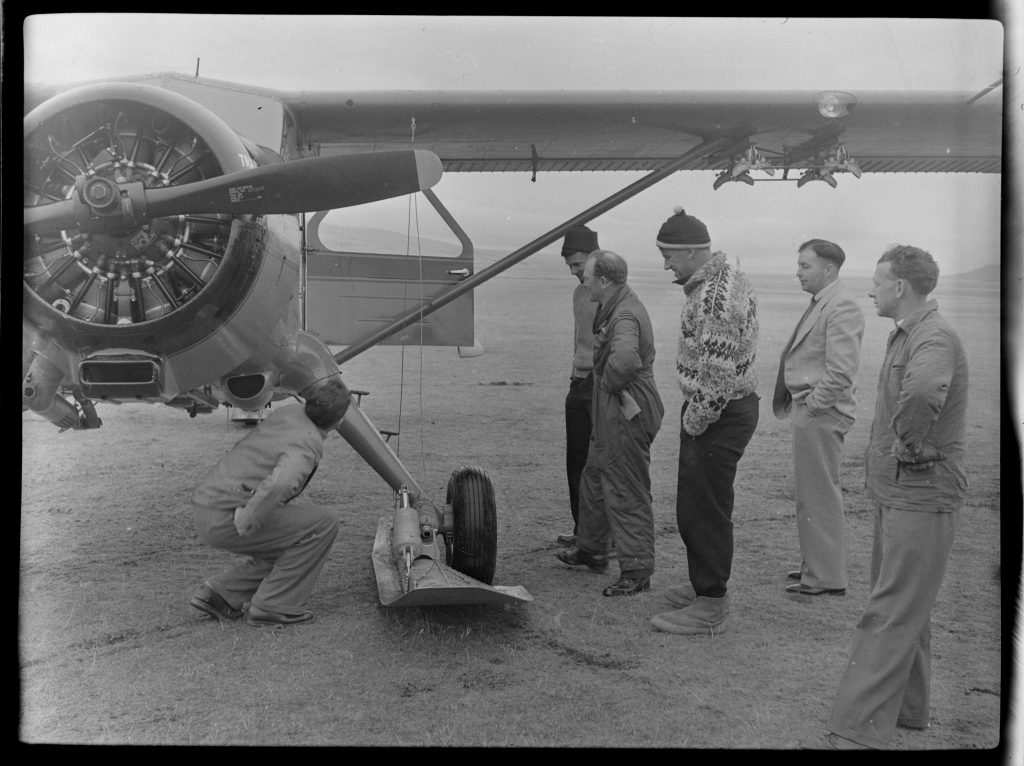
Sir Edmund Hillary in pullover (centre) and Harry Wigley (left) inspecting undercarriage of Antarctic Beaver Ski Plane with four unidentified men, Mount Cook Airfield, Mount Cook National Park, Canterbury Region. Whites Aviation Ltd: Photographs. Ref: WA-42014-F. Alexander Turnbull Library, Wellington, New Zealand. /records/30632576
Naturally, the world’s wires went wild, and soon even the Sultan of Brunei (yes, really) was keen for a few runs with Mount Cook Ski Planes of New Zealand. On subsequent flights, Sir Edmund Hillary hopped in for a ride. He was a close family friend. In fact, at just 13 and 15 years old, Harry’s children Brian and Sally had been charged with ski-stewarding Sir Edmund. He was a climber after all, not a skier, and known to require the odd bit of assistance if he fell, they said.
After 70 years, the sensations evoked during Harry’s inaugural ski plane flight live on through Mount Ski Planes & Helicopters. Snow landings are one of the country’s top tourism experiences, and the formula hasn’t changed a lick. Per conditions on a given day, a glacier or icefield is selected—Geikie, Tasman, Horace Walker—then static calm, silent rush and loosely contained euphoria. Run-ins are so smooth it’s tempting to suppose the craft hasn’t touched down at all. This, despite the fact that each specialised plank weighs as much as an Alaskan Malamute and sports a skiable surface area akin to a mini-bar.
It is just like it was on that day in September, when a reporter from the Timaru Herald wrote about joining Harry on the second-ever ski plane flight: he was “impressed by the cushioning effect of the snow. There was no bumping—it was like landing on cottonwool.” Upon marking the aircraft’s 70th anniversary, members of the Wigley family expressed great satisfaction to see Harry’s tradition carried forward so seamlessly.
Perhaps they see his grin through the cockpit glass still.
Words: P.M. Fadden
PHOTOS: Tori Harp
