The 1964 guide to storied cemeteries of the rural South.
When I was a kid, someone told me to hold my breath whenever I passed a graveyard, or else the souls of the dead would slip in. Boo! I still do it out of habit, which happens a lot when I’m travelling the roads of Te Waipounamu’s far south.
It’s not that there are an unusual number of cemeteries in the region. It’s more that there’s something about the remoteness of Aotearoa’s lower reaches and the inhospitality of the environment that makes them more noticeable. Maybe it’s the way weather is written in the trees, rows of them twisted resentfully away from the prevailing onshore winds, many of them lifeless, bleached. Thoughts of mortality creep to front of mind.
This sounds dark, and it is. But also, exploring graveyards is about far more than existential dread. Beyond being memorials, cemeteries tell stories and reveal histories. In the case of the kind of settler colonial graveyards listed here, for example, there’s a chronicle of immigration patterns and family life. Epitaphs are a history of typography; headstone designs tell us about art. Some graves are lovingly maintained, others neglected, all are a reminder that we will be remembered, or we will not. But to end up resting forever somewhere imbued with peace and beauty is at least something. That’s what I think of mostly when I stop to visit these places full of strangers long gone: “laid to rest”. – LW
We need your help
READ MORE
Albert Town Cemetery, Wānaka
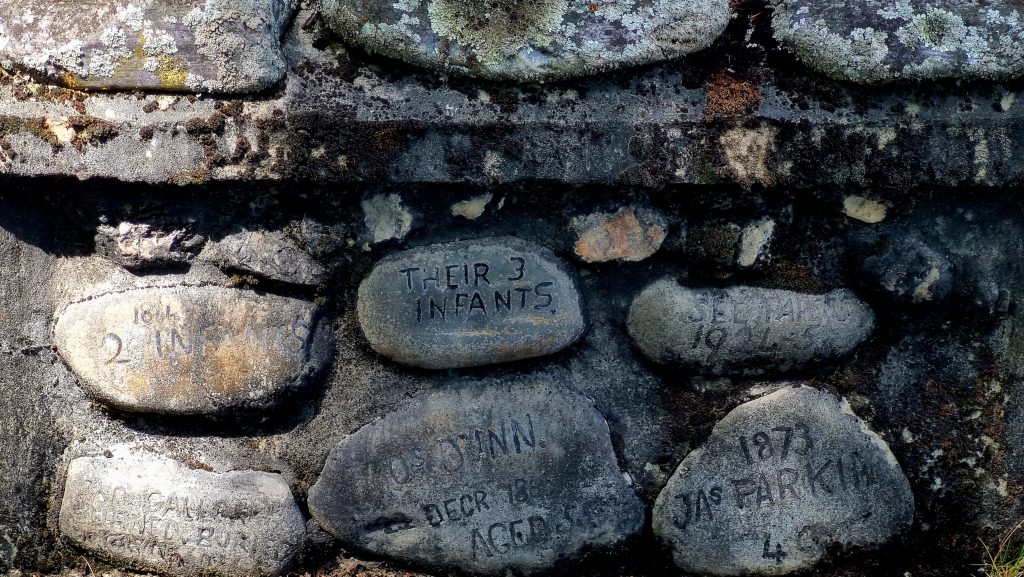
Tucked among the tents and the JUCY campers in the Albert Town campground, a low chainlink fence demarks a patch of grass. There’s a modest structure at its centre made of river stones. It would be easy to just pedal by on your way to the nearby Deans Bank mountain bike track. Don’t.
The stones are what remains of the Albert Town Cemetery. Built in the mid-1800s and used until approximately 1883, it was the Upper Clutha’s earliest settler cemetery. Oral histories indicate about 30 people were buried at the site, though it’s hard to be sure; fire destroyed the original wooden headstones, and many of the gravestones that replaced them were displaced by floods.
In 1952, a group of locals collected as many remaining headstones as they could find, some of which had been commandeered by campers to make fireplaces. The roughly-engraved epitaphs were deepened by chisel and filled with black plastic, and the stones arranged into a memorial plinth. They make for sad reading, with several children named only as “their infants” or “child of”. A 2007 Queenstown Lakes District Council survey using Ground Penetrating Radar found more unmarked graves; council increased the size of the fenced off area to include them. So they remain, forgotten but also not forgotten, in the shadow of the poplars as the Mata-Au | Clutha River flows endlessly by. – LW
Ratanui Cemetery, Catlins
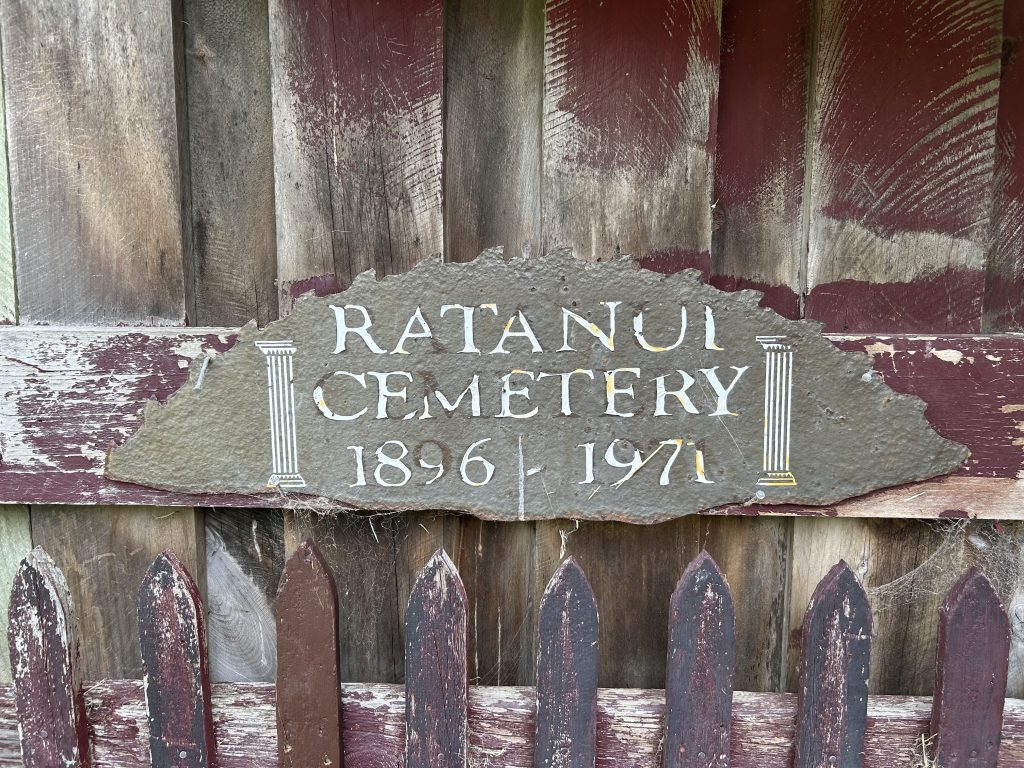
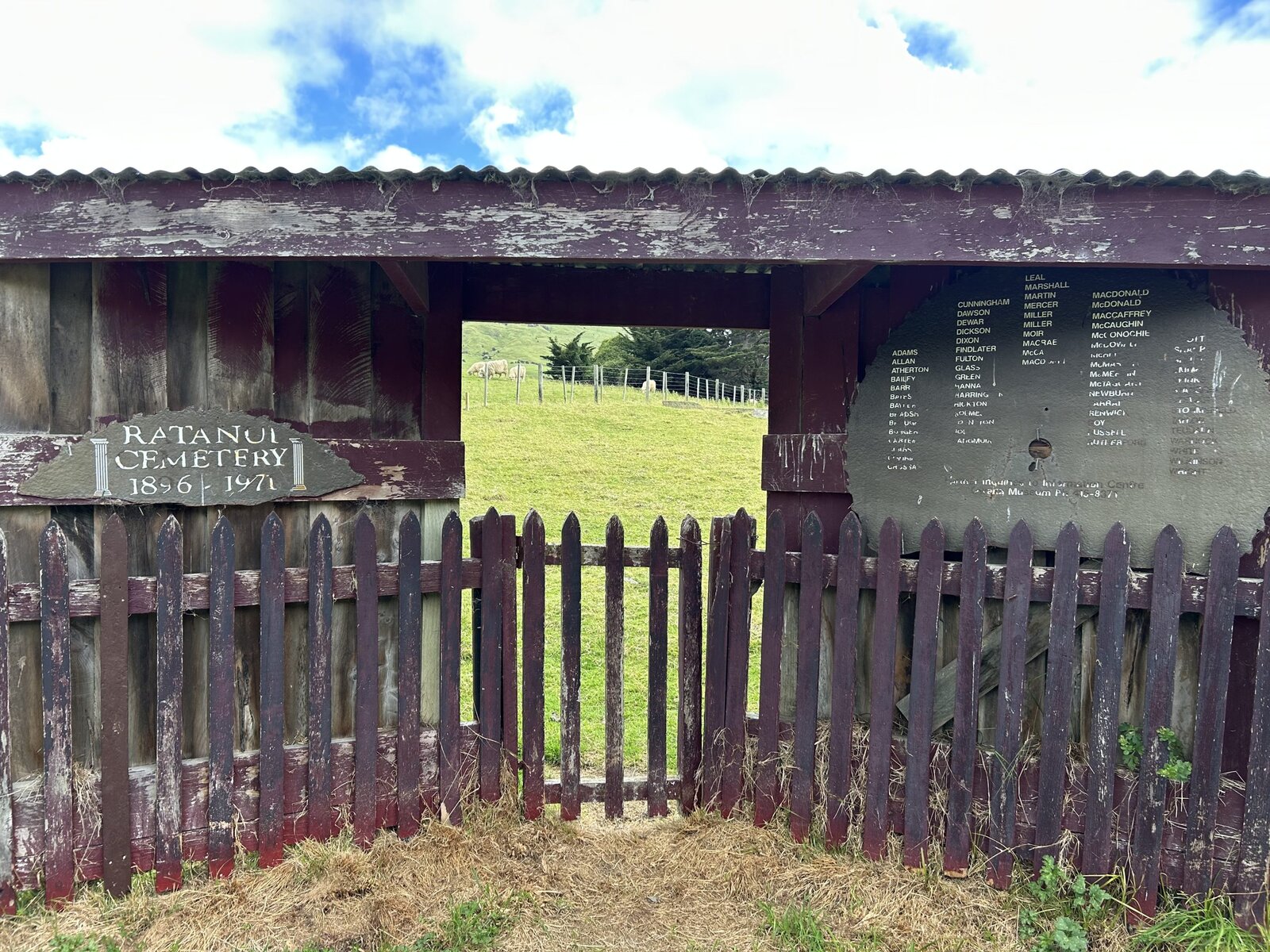
This one is dark. The Ratanui Cemetery is all that is left of a once thriving sawmilling community in the Catlins. Where there once was a school, cheese factory, post office and two general stores, there are now just graves. They tell of struggle and tragedy, of low life expectancies and high infant mortality, for this was an unforgiving place in an unforgiving time. Take Hannah McMaster. As one plaque explains, she had seven children, one who died within the first year, another, the oldest, who was “severely maimed”. Then her husband died unexpectedly. When she could no longer look after the farm and children, she was taken to Dunedin for medical treatment after “evidence of mental excitement, and being ‘mentally not too strong’”. – NW
Arawhata Pioneer Cemetery, Jackson Bay
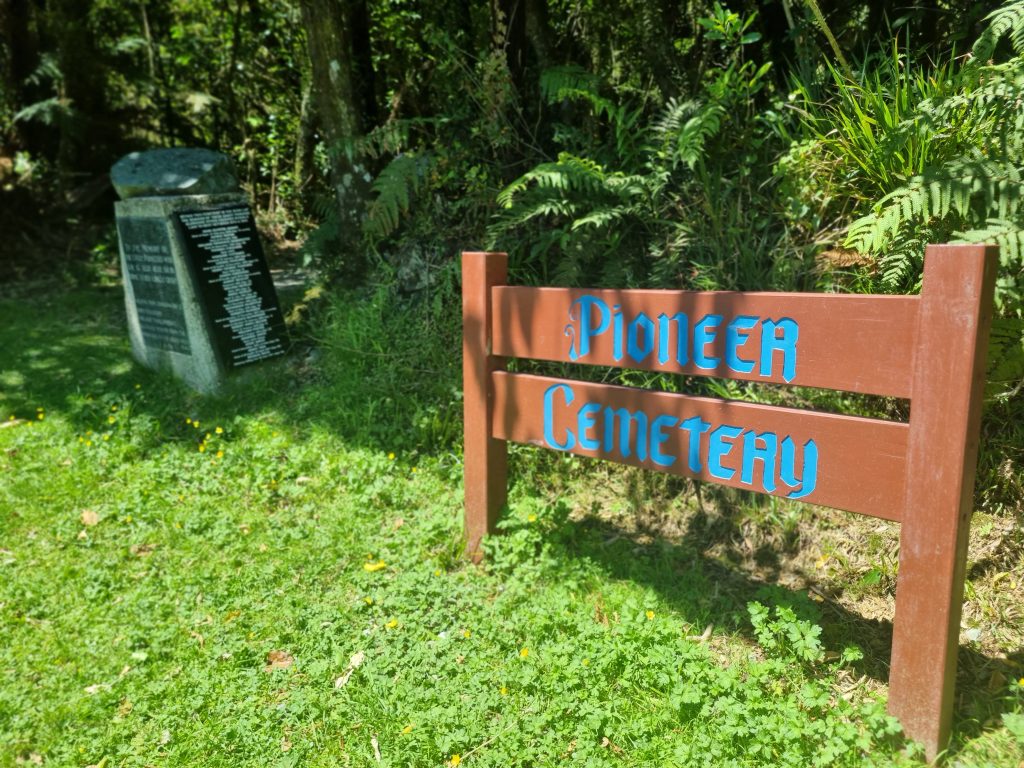
Tucked in the bush off the side of the Haast-Jackson Bay Road, not far past the ‘Caution Penguins’ sign, is what’s left of the Arawhata Pioneer Cemetery. It’s a legacy of what was a notably unsuccessful “Special Settlement” scheme, aimed at creating a seaport at Jackson Bay to service what would be a prolific farming district. Someone should have looked into the climate of South Westland first. An initial consignment of settlers arrived in 1875 (including Poles, Germans, Italians, Irish and English) and by 1878 there was a population of more than 400. But above-expected rainfall drowned crops and flooding from the Arawhata and Waiatoto Rivers cut off access to food, building materials and medical care. Landslips were frequent and drownings common. By the mid-1880s, the area was mostly abandoned. Little is left of the cemetery; only a few discernable graves remain, some marked with headboards, some with wrought iron fences, some no more than rocks arranged in an oval. Thanks, however, to the tenacious research of Lake Hāwea’s Kathryn Bennie, who has a holiday home in Jackson Bay, a plaque was installed at the cemetery’s entrance in 2025. It lists 21 of the people now confirmed to be buried at the bush-clad site. Their names, at least, are now remember-able. – LW
Lynwood Cemetery, Te Anau
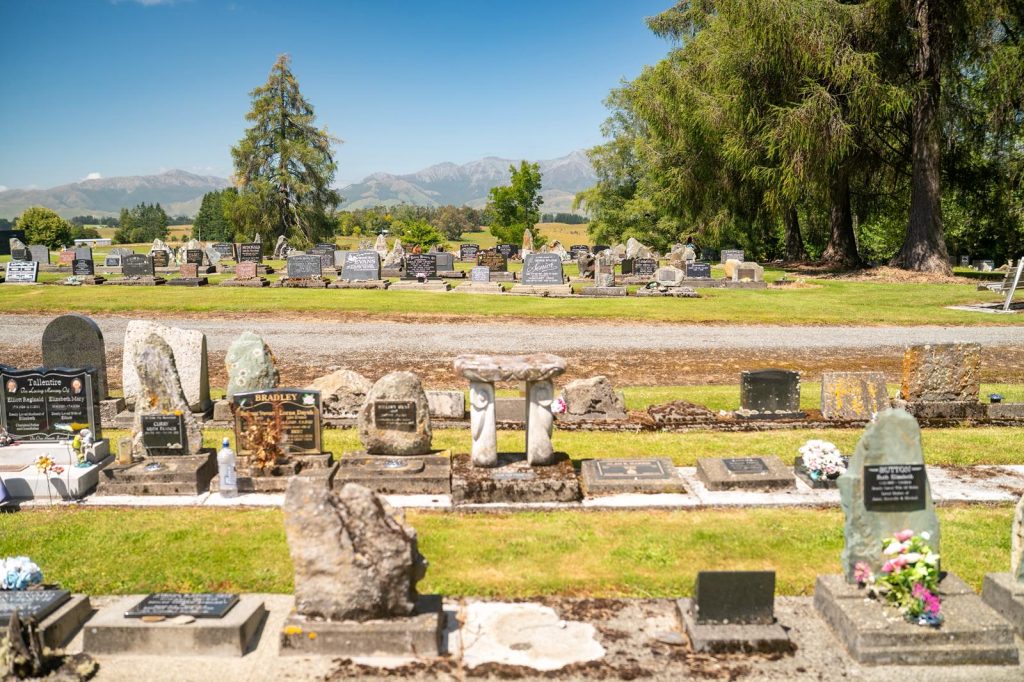
PHOTO: Mat Goodman
It’s 15 kilometres from the centre of Te Anau to Lynwood cemetery, making it a pilgrimage of sorts to drive a casket up along the Whitestone Road to the gentle hilltop and white swinging gates. The local community board came together to create the Lynwood Cemetery in 1974. Before then, all the local deceased were buried in either Mossburn or Lumsden, much further away.
The timing was perfect, however, to receive the too-young and too-many helicopter pilots, shooters and local crayfishers, who died during the helicopter recovery era as it crossed over with the boom and bust of the crayfishing industry in Fiordland. Accompanying both were a fair few road accidents, likely accompanied, if not caused, by a decent dose of alcohol. Hopefully, the next round of whiskeys were downed back in Te Anau after their mate was interred in the Lynwood Cemetery.
It’s a peaceful spot here, as most cemeteries are. The trees have grown up, so there’s little in the way of a view over to the Murchison Range and Fiordland, where so many died. Instead, the view is to the southeast, to the rolling hills of the Te Anau basin, dotted, ironically, with deer farms. The original source of the deer on those farms came via the helicopter venison industry, at the hands of many of the pilots and shooters buried above.
What’s striking here are the tombstones: the standard, manicured and engraved slabs are instead replaced by large rough-hewn rocks, most schist, some granite, echoing the mountains beyond. There are the brief inscriptions, ‘Here is the Hunter, Home from the hills.’ Except that for most, of course, they did not make it home, at least not alive. – PC
The Lonely Graves, Horseshoe Bend, Mata-au
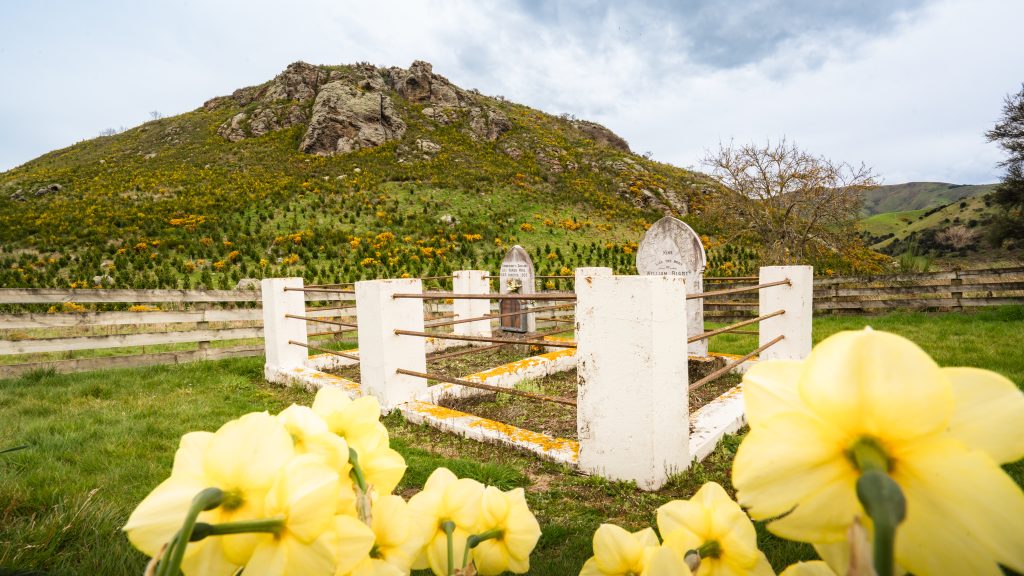
PHOTO: Brook Sabin
Despite being set in the middle of nowhere near a bend in the Clutha River, these might be the South Island’s most famous gravesite.
In 1885, a man washed up, deceased, on the banks of the Clutha at Rag Beach. An inquest determined he was most likely Charles Alms, a butcher from the Nevis Valley, although he was never positively identified. He was interred in an unmarked grave at Horseshoe Bend. Unmarked, that is, until the miner William Rigney organised a marker for the site: ‘Somebody’s darling lies buried here’. When William died in 1912, he was buried, as he requested, next to the grave. His epitaph reads: ‘Here lies the body of William Rigney. The man who buried Somebody’s Darling.’ The headstones remain a testament to the care we humans can show for strangers, when we care to. – LW
