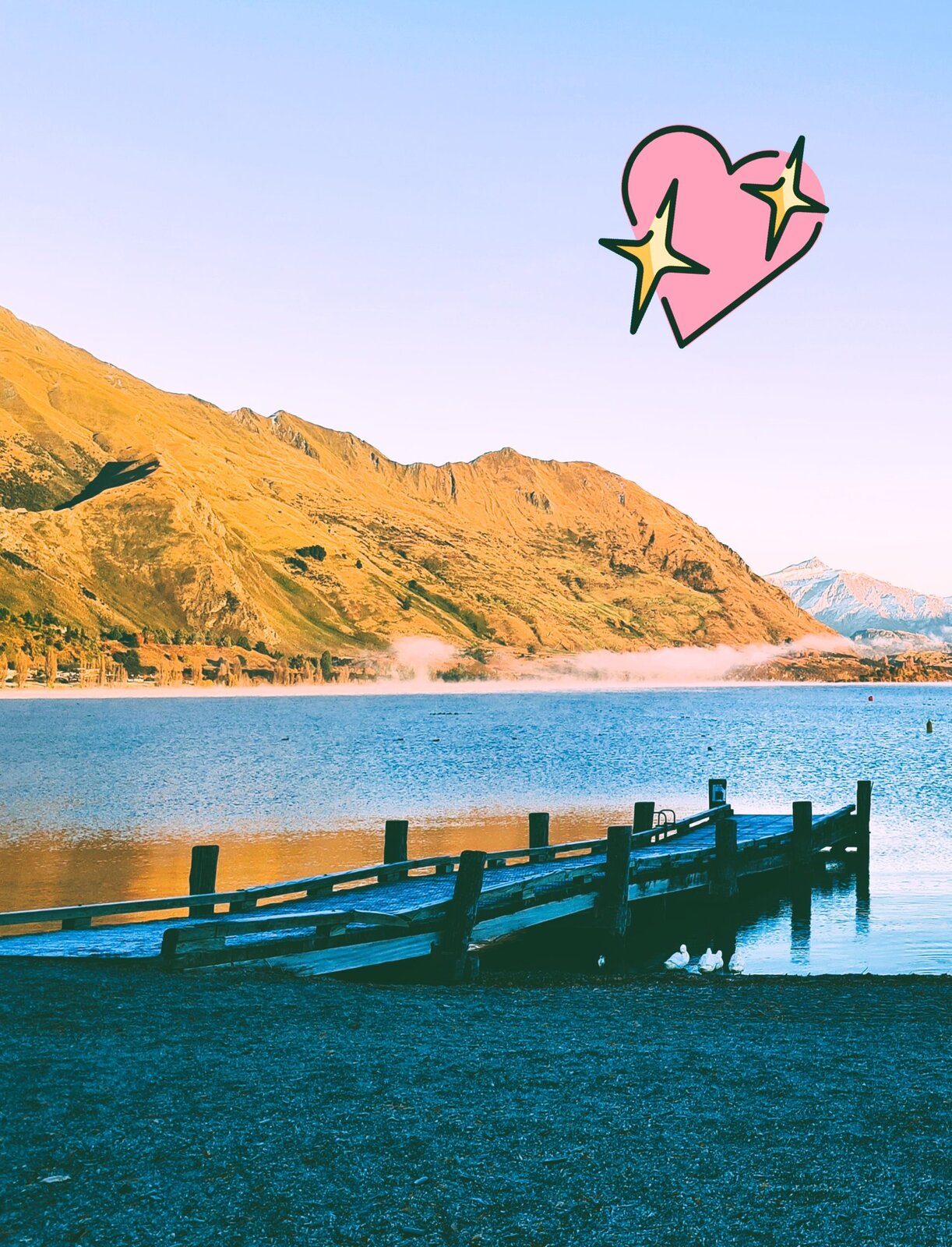
Romance writing is having a moment. We found this out after Wānaka-based writer Catherine Hart got in touch with us about sending us a romance-style story set in the town. Why not, we thought. A quick Google delivered promising headlines like ‘Gen Z loves smut. NZ authors are cashing in’. Thank you RNZ.
And we did a deep dive into Heated Rivalry, the screen adaptation based on Rachel Reid’s Game Changers books, which is a MLM (men loving men) sports romance series set in the world of professional ice hockey. It’s the number one show on earth right now. After more than one re-watch (known as a “Re-Heat” in fan parlance), we can see why.
Laura Williamson caught up with Catherine to find out more about the romance genre, and what it means for her and its growing community of fans here in Aotearoa and around the world.
I’ve never really delved into romance, but now that I’ve started, I think I’m hooked. How did you get into this kind of writing?
I found romance during Covid lockdowns and became obsessed. The novels contained accessible writing with emotion-fuelled plots and lovable characters, and were therefore addicting. The genre lends itself to escapism very well, and I think that is why people flock to it.
We need your help
READ MORE
In a literary sense, what defines “romance”?
For a romance novel to be considered romance it needs two things: A Happily Ever After (HEA), or a Happily For Now if the author and characters prefer it that way, and a plot that focuses on the romance above other storylines. If a novel doesn’t meet these criteria, it’s a novel with romance, but not a romance genre novel.
I keep reading about “smut”. Please explain.
Smut refers to spicy romance, but it’s different to erotica, which is typically less concerned with a character’s emotional journey. Its popularity has exploded in recent years. One of the (many) things Heated Rivalry gets right is the importance of emotion in the smutty scenes. Good spice is charged with a character’s need to express or prove something to the other character(s), or themselves. If a spicy scene changes the characters or story progression in a way that means they cannot go back to the ways things were before, it will never be gratuitous.
Speaking of exploding popularity, why do you think romance is so popular at the moment?
Romantic fiction is about the things that matter most. It is about how we create whānau and community and where that starts. It is a celebration of love and everything that happens because of it. Yes, there’s tension, but there’s also kindness and acceptance and lessons to be learned. These are the books that are selling; these are the stories people want to hear.
Plus, romantic fiction handles big themes: chronic illness, disability, divorce, death, betrayal and despair. Depression, anxiety and PTSD often appear – trauma, almost always. Pain, too. There’s politics, racism, fatphobia, sexism, classism, homophobia, all kinds of hatred and fear. There is no subject too big or too bleak for there to exist romantic fiction about and around and because of it.
Romance writing is often dismissed as lowbrow and frivolous. Yet you did a Masters thesis centred on the genre.
It was a shock to my classmates as well – I remember one of them introduced their work by saying, “the book I’m writing is about a couple, but it’s definitely not romance.” Right after I had to say, “well, mine is typical romance.” And it was genuinely hard to find academic articles to reference. For my studies, I examined how the romance genre treats gender and sexuality, focusing specifically on heteronormative ideals, including those that deal with monogamy. I was looking into queerness and polyamory within romance genre novels, and I wrote a full Sci Fi romance novel featuring one trans human, one human woman and one male alien.
Amazing. I would read that. Tell us how the Wānaka story came about.
A small-town romance typically follows specific tropes or points, like a meet cute (a funny or charming first encounter), a secret, an initial reluctance followed by an admission that the romance can’t be ignored, a get together, a breakup and then a HEA. The relationship for this piece is, in a way, between me and the town, which is anthropomorphised with the character Chase. The stereotypical Wānaka adventure becomes a romance hero we can swoon over.
Originally, I thought the work would be sarcastic and almost satirical (easily done when you’ve known Wānaka for more than 20 years), but as soon as I started forming the plot, this didn’t fit. For a romance to meet readers’ expectations, the building relationship has to be sincere for the reader to get swept away.
And have a Happily Ever After!
It is the happy ending that throws people. Some think this is what marks these books as simple escapism, even fantasy. But life is full of moments that might function as happy endings, if anything ever ended. The problem with real life is that it goes on; the joy of a book is that it can stop at the perfect point.
Swoon.
—
Small Town, Big Heart
The Set Up
I drop my bags at the door and gaze across the lake at the mountains. This will be my view for the next month while I stay in the Airbnb with shiny floors and fresh furniture that is costing me a small fortune.
The table beneath the veranda will be where I drink my morning coffee, and I’ll find a blanket for garden reading in the weekends. I can already map out how my time here will go.
The sun beats down on the A-frame building, pollen floating through the air as if it’s whispering, “Bees like me more than you.” I sneeze and agree.
The Meet Cute
I order my coffee and stand aside. The espresso machine whirrs, the noise grinding against my eardrums, but other than that the cafe is quiet, filled with locals whose order the barista knows by heart.
My phone beeps with another email, but before I can reply, a huge, hulking form bumps into me.
I turn my head and gasp, the sound loud and prompting the couple in the corner to stare.
The man looms above me and I was ready to bite his head off but instead I’m dumbfounded. He’s breathtaking. Huge. Hair like whisps of clouds, falling across dark blue eyes you could drown in and cheekbones so prominent you could belay off them. And those lips. I could write sonnets about those lips.
From the smug grin spreading across those sun-kissed cheeks, I know he’s seen me seeing him, and I know he likes to see it.
The man turns to face me, his back to his friends and asks, “What’s your name?” His voice is deep, rumbling like the hills surrounding us. There’s a touch of entitlement, as if I owe him my name after ogling him so thoroughly. Which kind of seems fair.
When I tell him, he gives me this look, this deep, longing look that implies I now belong to him.
“I’m Chase.”
The Connection
We go out for dinner the next night. He takes me to the Indian restaurant that feels like you’re eating in someone’s living room but serves the best butter chicken I’ve ever tasted. Then we walk to get ice-cream and slurp our cones on the pebbled lakefront.
He tells me about rock climbing, mountain biking, hiking, skiing, kayaking, swimming, paragliding, trail running, even hunting and fishing. He talks about how the tourists don’t know how to drive and the locals drive fast. He teaches me that sustainability is key to keeping this landscape beautiful.
He licks the ice-cream from his lips with barely restrained promise and I know I’m a goner. I don’t mention that I fly back to Auckland in three weeks. Chase doesn’t need to know that yet. People come and go from this place all the time, so he tells me.
It Won’t Work
I can’t stay here with him. I won’t. I have to go back to Auckland, to my job where I do things that need to get done and to my car that has to sit in traffic or I’m sure it will combust from neglect. Whatever he has to offer, it can’t be better than my life before I came here.
It doesn’t matter that he offers adventures in the mountains, or walks along the river, or cosy nights in front of the fire. I can’t stay.
I don’t care if he knows the best op shop in town, or the spot everyone goes to watch the sun set. I don’t care if he knows everyone and they all seem to love him.
“It’s just not for me,” I think as I close my work computer for the day and get ready for our date.
Maybe It Could Work
But I like him. Everything feels closer, more at home when I’m with him. I could bury into him, lay my claim on him like laying claim to land that was never his to begin with and bask amongst the tall trees.
I tell him I have to go.
“Is Auckland really better than staying here with me?”
No. Maybe. I don’t know anymore. If I’m being honest with myself, I know he makes everything better.
It Won’t Work #2
Definitely won’t. It can’t work. I need to hustle and bustle in my relationships. I need to be the one to make the moves and do the thing and work really hard. This is too easy. It doesn’t feel right.
But even as I have the thought, he tucks me in, my head resting against his lump of a shoulder.
I Want It To Work
We eat breakfast in the garden just like I’d imagined. Chase brings fresh eggs he gets from the side of the road where his neighbour keeps an honesty box. His leg jiggles, like he can’t wait to be moving again. He’s a constant mover until the evening, when everything gets quiet and we can relax.
I’m falling for him, even if I can’t say the words out loud yet. The way he includes me. The way he shows me new places. It shows me I’m worth something to him. It’s like if he shows me all the good spots, I’ll never leave. Maybe he’s right.
The idea is terrifying. The concept of a relationship that doesn’t hurt me is foreign. It’s the first time I’ve dated in years after meeting someone organically and not on the many dating apps people my age are forced to rely on, which I’ve deleted from my phone.
It just can’t be this good. Surely this is not real life.
Chase has more to offer than anyone else ever has. Between lazy days in the sun and adventures every weekend, I’m feeling more and more at home with him.
The Inevitable Break Up
I leave. It was always the plan. My life back in Auckland can’t wait any longer. I need to get back to going into the office – there are only so many work-from-home days they’ll allow.
Chase tells me he’s devastated, that he’d begun picturing our life together. But it feels like playing pretend at a life that isn’t mine.
I’ve lived in Auckland for almost ten years. I’ve put time and energy into my life there and it’s not so bad as everyone here says. It can be nice in the suburbs with the trees and the birds and the sea.
But the minute I land, I know it’s a mistake. It sinks into my bones as I inhale the pollution and meet a jam on the motorway, waiting for half an hour even though the offramp is barely a kilometre away.
The Grand Gesture
I quit my job. Decide it’s worth risking everything and I’ll regret it if I don’t.
If it goes wrong, I’ll just move back to Auckland, right?
Chase has become my home. Where I feel safe and happy. Where it’s quiet and I can hear myself think and I don’t have to wait for someone else to tell me I’m living my life in the “right way”.
I’m going to find a spot in his life for myself.
I can’t believe I ever thought I’d be happy in Auckland after being with him.
At the airport he holds a sign with my name on it and a giant grin splits his face in two. Someone claps when I run to him but I’m too busy wrapping my arms around his thick chest to respond. He smells like grass and fresh air and feels nothing like the city.
The Happy Ever After
I never do leave. I never need to. I’m where I’m supposed to be.
Home is here now.
Catherine Hart
